Visual Perception
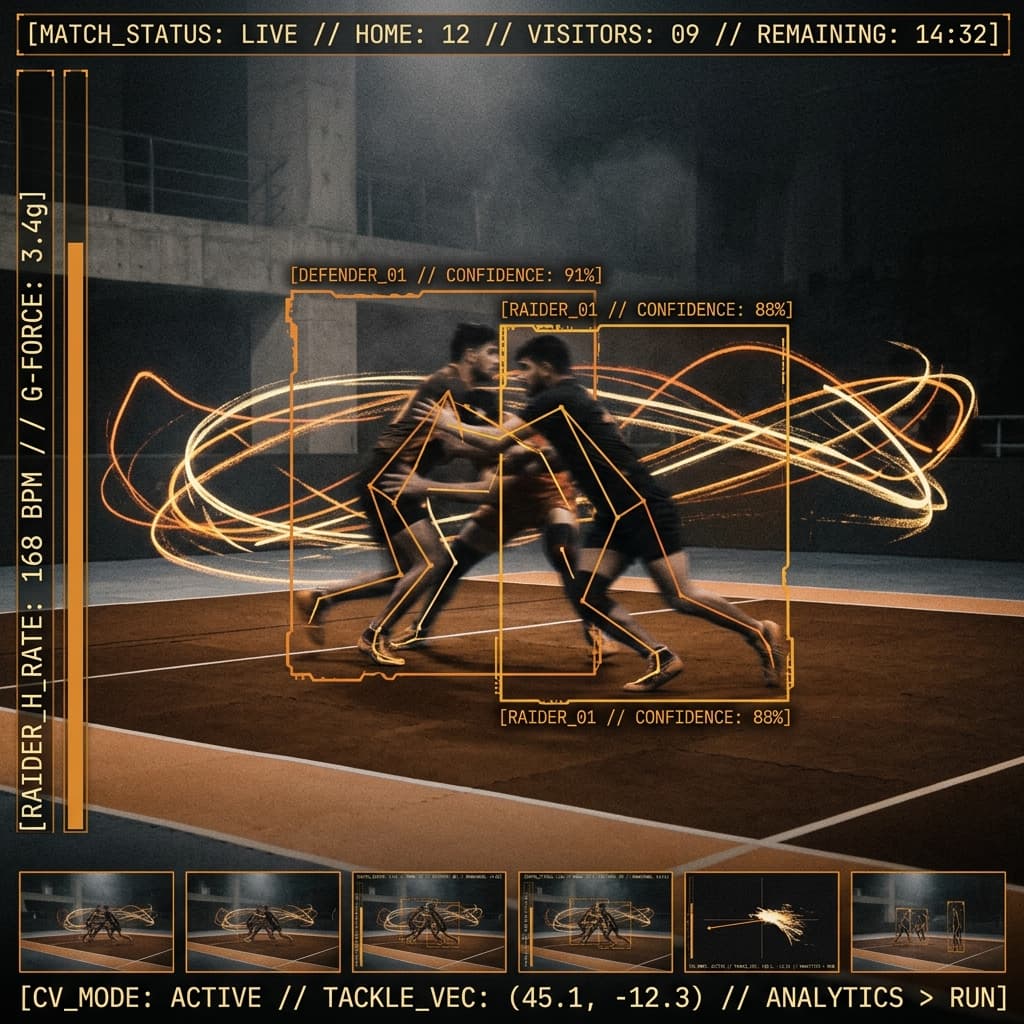
Tracking objects in extreme chaos. In Kabaddi, a tackle involves up to eight players compressing into a 2-meter radius. Standard object detection drops bounding boxes instantly due to occlusion. Here is how we solved it using a hierarchical computer vision pipeline.
Court Keypoint Localization
Court detection is the first stage of the perception pipeline. Its primary objective is to identify key court landmarks and establish a geometric reference for spatial reasoning.
We employ a U-Net-based architecture to overlay detected structural lines and labeled keypoints directly onto the broadcast frame. The module identifies the top, bottom, left, and right court boundaries, the bonus line, and the baulk line, with 8 specific keypoints marking the precise corner and line intersection positions. This precise localization is what makes downstream Bird's Eye View transformation mathematically possible.
Architecture Detail: Temporal Smoothing
Broadcast cameras constantly pan and zoom. If keypoints are calculated frame-by-frame independently, the resulting data will jitter severely, ruining any velocity calculations later. We implemented a temporal smoothing layer that applies a Kalman Filter across sequential frames to stabilize the detected keypoints, ensuring geometric consistency even during rapid camera movements.
Architecture Detail: Re-ID
When a raider attempts a Dubki (ducking under a chain tackle) and disappears from the camera angle, bounding boxes drop. To solve this, the re-identification (Re-ID) mechanism, powered by an Omni-Scale Network (OSNet) backbone, extracts visual features and maintains their identity state by encoding their velocity and appearance before the occlusion occurred. Once they emerge, DeepSORT instantly re-assigns their original tracking ID.
YOLOv8 & DeepSORT Tracking
K-RAID employs a hierarchical matching strategy. First, YOLOv8 generates bounding boxes on 30 FPS broadcast footage.
Because kabaddi involves extreme physical compression, we cannot rely on simple Intersection over Union (IoU) matching. We integrate DeepSORT for Multi-Object Tracking (MOT). This allows the system to predict the future position of every player based on their current trajectory kinematics, maintaining track continuity even when physical overlaps occur.
State Machine Outcome Detection
Tracking players is only the first step. The system must also understand the semantic state of the raid. Is the raider safe? Was it a tackle?
We implemented a definitive State Machine to classify the raid outcome. By analyzing the temporal overlap of bounding boxes between the raider and defenders, the system detects "Touch" events. If the raider subsequently crosses the midline, an "Escape" is registered. If the raider is pinned and remains within defender bounds for a continuous threshold of frames, a "Tackle" is declared.