Adversarial Synthesis
To eliminate AI hallucination, outputs cannot be trusted automatically. The Synthesizer's draft must pass through a strict, data-grounded Reviewer Agent before reaching the user.
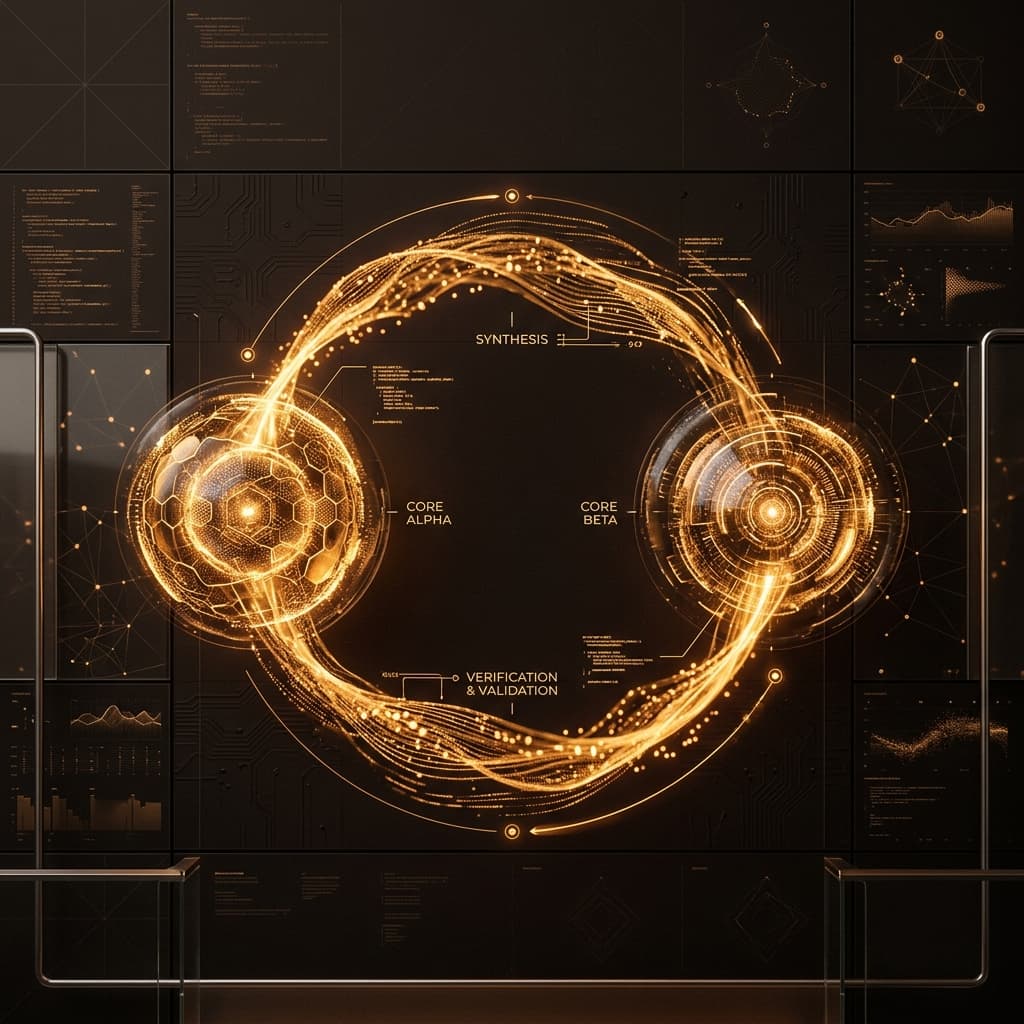
The Synthesizer Agent
The Synthesizer is responsible for combining outputs from all active agents into a single coherent response. It acts as the convergence point of the entire agentic pipeline.
It integrates information from multiple sources: retrieval results (FAISS precedents), analysis insights (ST-GCN scores), simulation outputs (Diffusion kinematics), and textual descriptions. The synthesizer ensures that the final response reflects a comprehensive understanding of the raid, presenting all these analytical perspectives in a coherent, query-aligned format.
The Hallucination Problem
Even with perfect ground-truth inputs, Large Language Models have a tendency to invent confident, false conclusions (e.g. claiming a tackle failed because the raider was too fast, when the math actually shows the defender slipped). This is why the Synthesizer output is strictly considered a "Draft" rather than a final response.
Iterative Refinement
If the Reviewer rejects the draft, it appends the mathematical proof of the error (e.g. "Analysis Agent data shows the right corner held position until 3.1s. Fix this discrepancy.") and forces a regeneration. This adversarial loop continues until absolute mathematical consistency is achieved.
The Reviewer Agent
To ensure absolute reliability and correctness, K-RAID implements an adversarial Reviewer component.
The Reviewer evaluates the Synthesizer's draft by checking whether its natural language claims are logically supported by the underlying Bird’s Eye View coordinates in the Global State. If the Synthesizer claims the raider moved left, but the BEV JSON shows an X-coordinate increase to the right, the Reviewer flags the inconsistency.